Manikjore (1952)
Director: Kalipada Das; Writer: Kalipada Das, Abani Bandyopadhyay; Cinematographer: Dibyendu Ghosh; Editor: Nikunja Bhattacharya; Cast: Nabadwip Halder, Shyam Laha, Ashu Bose, Biren Mitra, Arun Mukherjee, Tarun Mazumdar, Rajlakshmi Debi, Shyamali Chakraborty, Jharna Chakraborty, Shelly Banerjee
Duration: 01:34:02; Aspect Ratio: 1.335:1; Hue: 60.396; Saturation: 0.008; Lightness: 0.211; Volume: 0.199; Cuts per Minute: 3.551; Words per Minute: 70.337
Summary: The classic comedy double act of Nabadwip Halder and Shyam Laha, seen in numerous films like 'Kalochhaya' (1948), 'Baikunther Will' (1950), 'Hanabari' (1952), 'Sharey Chuattar' (1953), 'Saheb Bibi Golam' (1956) feature in rare lead roles in this film by Kalipada Das. Mostly heavily criticized at the time of release, what makes 'Manikjore' historically significant is the fact that it is a remake of the silent short 'Jamai Babu' (1931), also by Das, the oldest Bengali film that exists today. The character essayed by Das in the original is divided among the two brothers-in-law, only one of whom had been central in the original silent film. Major gags, like the mix-up with the 'Commit No Nuisance' sign, are repeated here too, and the comedy, heavily panned, remains slapstick and stumbling.
The film is about two bumbling country bumpkins and life-long friends, Naba and Gaba, who come to Calcutta to their wives and in-laws after a few months of misunderstanding. However, the two simpletons find themselves at odds with the city space and its mostly dishonest people, with hilarious repercussions.
Release date: 5 December, 1952 ( Minar; Bijoli; Chhabighar)
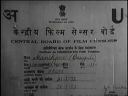
censor certificate

Manikjore is actually a remake of 'Jamai babu', the oldest surviving film and the only surviving silent film in Bengali cinema. The director and lead actor of the original, Kalipada Das, remade the film almost twenty years later and brought in one of the most celebrated comedy double acts of the time, Nabadwip Halder and Shyam Laha, for the lead roles. The film also draws obvious inspiration from the Laurel and Hardy sketches as well as the slapstick comedy of the likes of Buster Keaton and Charlie Chaplin, including entire gags.

Train arriving at station

The protagonists are a pair of country bumpkins, life-long friends Naba and Gaba, who have just arrived in Calcutta. Co-incidentally sons-in-laws of the same family, they are clumsy, garrulous, and often infantile.
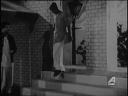
Besides their quirks, eccentricities and their general simpleton nature, the two men also continuously display a knack for getting into immense trouble over the smallest and oddest of things, like in this case the misplaced train tickets. A series of such gags of varied lengths about their misadventures majorly forms the narrative of the film.
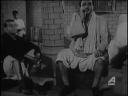
Gaba has been married more recently but is visiting his in-laws for the first time while Naba has been married longer. There is a suggestion of some sort of a fall-out which had resulted in Gaba staying away but that is never fully explicated in the film. The role of Gaba had been played by Das in the silent original while the role of Naba had been a supporting one which was expanded into a parallel lead role to accomodate Nabadwip Halder.
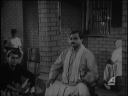
A classic case of mistaken identities where, except for one tiny detail, everything else is so similar that confusion ensues. Here, instead of their father-in-law Nutubihari Das , they end up at a certain Nutubihari Dutta's house.
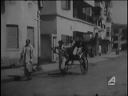
tanga rickshaw
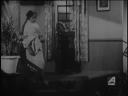
With the owners of the absent and unable to corroborate their identities, the staff of the house only assist in inadvertantly extending the misrecognition.
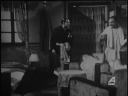
Their behaviours and reactions underline their inherent simpleton nature. This is, in fact, a running trope in the film, the unabashed amazement of the country boys at the sights and sounds of the new urban space. In fact, this amazement of the country entity in the face of the unrelentingly dominating big city is a running leitmotif in much of the cinema of the 1950s, at least in the early years after the Independence.
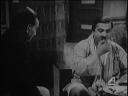
Furthermore, it is revealed that Gaba had been away for four months, since the time of his marriage and that the reason for the fall-out had been about some argument he had had with his father.
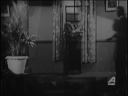
It is obvious that the people of the house are also expecting their son-in-law which has further added to the confusion.
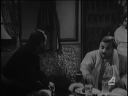
Naba, as it will become clearer, is the smarter of the two while Gaba is more immature. In fact, Gaba's infantile nature, be it in his gullibility, his general nature or even the way he eats, is foregrounded throughout the film. Though this is done mostly for laughs, it also serves to instill a sphere of innocence around the pair that is used to draw crucial comparisons with urban life.
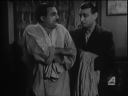
This comparison between the country and the city works at multiple levels in the film, according to particular contexts. Here, for example, one factor that is foregrounded is the inherent rudeness and arrogance of the people in the cities, displayed by the woman after she realizes some sort of misunderstanding has happened.
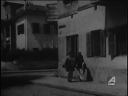
One of the most recurrent images in the film is that of Naba and Gaba walking through various built spaces of the city, at times aimless and unrestricted. We will talk about these images in greater detail a little later.
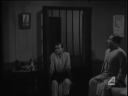
For the two friends, getting lost without any kin in an unknown city unexpectedly becomes the cause for an abrupt impromptu holiday.
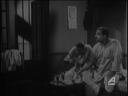
The duo meet their room-mate who has been living in the mess for the past five-six years. Also, the man's apprent niceness comes across as a refreshing change, given the kind of people the duo have met till now. Naba's assertion that they are friends emphasizes this.

The 'Commit No Nuisance' gag was one of the central gags of the silent original too. The duo, note down what is written on a wall near the hotel thinking it to be the name of the street, with no idea that what they have written is the public notice 'Commit No Nuisance'. The gag is an extended one, we see it's effects a little later.
As mentioned before, one of the central images of the film is that of the country duo walking through the various spaces of the city. In a way, this recurrent motif is a symbolic referent to the migration of the country to the city that was a prevalent theme in many films of the time. However, there are certain crucial displacements. These parts of the city, both colonial and yet exemplars of the post-independance urban space, could be inaccessible - like the house they inadvertantly enter and are chased out of - but they are in no way completely symptomatic of the country-city duality that invests much in the cinema of the time.
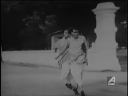
The hiding in the car sequence and subsequent discovery is a nod to similar episodes in classic Charlie Chaplin and Buster Keaton comedies.
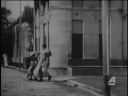
With the duo having lost their way, the narrative resumes the 'Commit No Nuisance' gag.
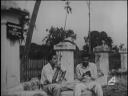
The two men are sitting and talking about the races, a persistant symbol of self-destructive behaviour and anti-social tendencies in Bengali cinema.
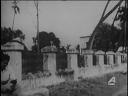
When the chit of paper is shown to the passer-by, it is obviously taken as a bad joke and the man reacts accordingly.
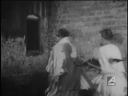
Naba, always having been proud of being the smarter of the two, is obviously ashamed about the road debacle. The unknown woman whose car they had taken shelter in is an easy invisible target to put the whole blame on.
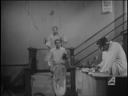
One major reason why the duo and their movement across the city is not entirely symptomatic of the migration of the rural poor to the city is the fact that unlike a film like 'Chhinnamul' which was of the same time and which showed the plight of the refugees as they migrate to the urban metropolis or Bimal Roy's 'Do Bigha Zamin' where the migrants come to the city as cheap exploitable labour, the spaces that the duo infiltrate here are mostly touristic. Of course, it ends badly for them almost all the time. However, that has more to do with the the perpetuation of the village simpleton imagery than an actual statement on the contemporary urban condition.
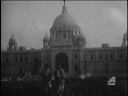
maidan
victoria memorial
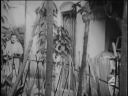
However, it is not that the city space is completely sanitised of all possible connotations opf repression and violence. Gaba being mistaken as a thief and getting beaten up may have been treated for laughs, but there is an underlying sense through the incident, and many similar incidents, of the unforgiving nature of the post-colonial city.
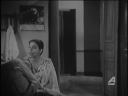
One factor that is re-iterated constantly throughout the film is the fact that most of the things that happen to the duo are direct consequences of their inability to conform to the codes of behaviour in the city and its inhabitants. The fight with a fellow boarder foregrounds this significantly.
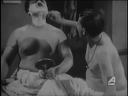
The woman they had inadvertantly gotten on the wrong side of turns out to be an acquaintance of the man who had befriended them in the mess. Also, the simple folk that they are, and unaware of the conventions that guide people's lives in the city, they unabashedly invite themselves for her birthday party too.
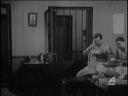
Another factor that runs as a subtext to the film and which re-inforces the country-city duality to some extent is the fact that the people of the city in Manikjore are majorly seen as inherently deceitful and/or unfeeling. For example, the man who had befriended them is suddenly revealed to be quite opportunistic when he convinces the duo to pay for his share of the birthday present too.

This factor is re-inforced in the very next scene when we see the man wooing the woman with the gift he has bought with their money.
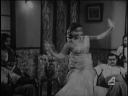
The dancing female figure was a symbol of the modern dance aesthetic that had gained immensely popularity especially among the bhadramahila in the 30s-40s as a direct reaction to conservative and aesthetically bound forms of dance prevalent during the time. However, during the 50s, this form of dance goes into a significant decline with it being incongruous with the new project of nation-building that needed to make the female body sacrosanct. The heroine, henceforth, never dances and even if a minor female character dances, she is generally the vamp. What becomes interesting here is the fact that the song is not in Bangla but in Hindi, an already alienating element that effectively rids the dancing body here of context and charge. This move is complemented by the comic episode at the end when the duo drop the earthenwares full of sweets while trying to clap.
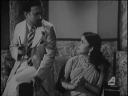
With the man's true nature already revealed, his rude behaviour here and his obvious shame at being associated with the two men underlines the hypocrisy, deceitfulness and two-faced nature of the city as against the innocence and guileless country. Parallel shots of the man getting more and more enraged at their behaviour and the two men eating to their hearts' content perfectly underlines this difference. One must mention that Naba, being the more practical of the two, does attempt to restrain Gaba who is almost infantile in his approach to the world around him. In many ways, despite the threads of social criticism that sporadically appears at various points of the narrative, it is undercut or laughed away in such a manner so that it never really congeals into any lasting critique. Naba and Gaba, for want of a better expression, remain stock comedic tropes or situations and never emerge as actual characters.
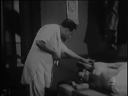
Naba and Gaba are mostly unmoved by the chaos they have created the night before, or perhaps to them it does not appear as cataclysmic and shameful as it appears to their room-mate.
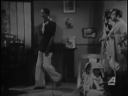
The long photo studio sequence is yet another instance of the exploitative and potentially dangerous side of the cityscape. Besides, the mix-up with the photo will become a crucial comedic plot-point later.
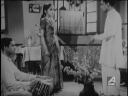
The fact that Naba and Gaba lack the knowledge of the social mores and conventions is something that has already been made abundantly clear. Thus peeping into someone's home because they want to see the girl dance does not strike them as an improper thing to do and this also explains why all their escapades end similarly.
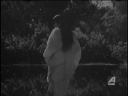
The song sequence is interestingly shot in a film-within-a-film format, one of the earliest instances of such a plot device in Bengali cinema, used to aid the slapstick that ensues after the scene.
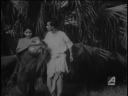
The two simpletons mistake the film set for a real life scenario and seeing the damsel in distress jump to the her rescue, as usual leading to chaos.
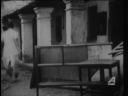
In an exact repetition of the earlier car gag the duo are chased and they run and hide in a trunk that is being moved by a family. Interestingly, the other boarder the two had fought with previously is the man of the house, and he obviously still holds a grudge.
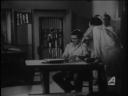
It is noteworthy how many times the two men from the country are mistaken for thieves in the film and then consequently excused as witless fools. In fact, the witless country bumpkin is a stock figure for a prototype unblemished innocence. This will happen later again. However, this time, their misfortune works to their advantage miraculously as the police officer recognizes them and aids them in reaching their in-laws' house.
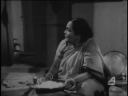
The house of Nutubihari Das, the father-in-law of Naba and Gaba.
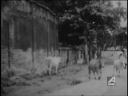
The triumphant arrival of the duo at their in-law's is marked as usual by the misunderstandings that seems to follow them everywhere. Here, the maid, mistaking the police sent to escort them there, informs the family that the two have been arrested and will probably be hanged in an example of characteristic middle-class paranoia about the police and the judiciary.
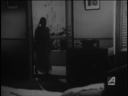
As mentioned before, the cause of the rift is never really addressed though it is obvious that it was grave enough to keep both of them away from their wives.
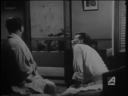
Gaba, who has not seen his wife since their wedding, is understandably shy and excited at the prospect of meeting her.
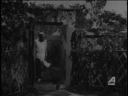
The old man's joke about his wife smiling and thus it being an auspicious moment is made more topical by the fact that the wife is played by Rajlakshmi Debi who had made a career out of playing strong, loud, unsmiling matriarchs who ruled with an iron fist, for example as the slum landlady in 'Do Bigha Zameen'.
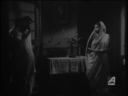
There was an abrupt kiss in 'JamaiBabu' between Gobardhan and his wife, a nod to pre-censorship depictions of sexuality in early Indian cinema. Twenty years later, after censorship has emerged as a powerful force, in the post-Independence context, with a new idiom of society and the middle class having emerged, sexuality in the domestic sphere is entirely excised. Instead the scene is extended, with the shy Goba clumsily attempting to woo his new wife and the long-married Naba being more forthright. This situation also gives rise further questions regarding the living arrangements and their marital life in general because it seems a tad bit odd that Naba too was away for so long.
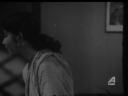
Gaba and his wife's interaction in the morning foregrounds their slowly growing relationship and sets up the final gag of the comedy.
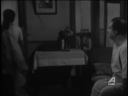
The final gag where Gaba feigns illeness, in order to spend more time with his wife, was also the final gag in 'JamaiBabu'. Unlike, the silent original though, this is not Gaba's idea alone but Naba has an equal part to play in it.
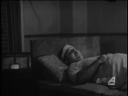
Their efforts are so earnest that when the stories of the past few days come to light, everyone assumes that Gaba is actually unwell. An increasingly rapid series of shots shows how the duo's plans have succeeded in creating concern.
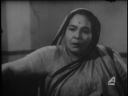
In a funny turn of things, the Ayurveda doctor, also confirms that Gaba is ill, with Naba playing a convincing part in establishing the dubious diagnosis. The doctor's assertion that sudden death is possible in such cases too only serves to increase the irony and humour of the sequence.
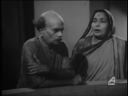
Completely destroying the carefully constructed ruse, and probably due to the doctor's diagnosis, Gaba's father-in-law decides that the girls are too immature too nurse him and decides to do the job himself.
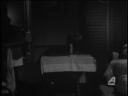
Much to Gaba's disappointment, it is not his wife as Naba had promised, but his father-in-law who has not left his side the whole day.
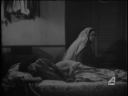
Naturally, Gaba's mother-in-law has linked this latest misfortune of the illness with the same divine displeasure that according to her has kept Gaba away from his new wife for so long.
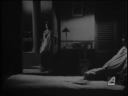
Naba's superimposed photograph from the earlier sequence in the photo studio makes a comeback when his wife finds it and assumes that Naba has a mistress. She rushes out in anger prompting Naba to go after her.
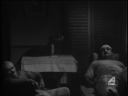
As mentioned before, since the film consists of a series of gags with a threadbare narrative, the ending, though abrupt, fits the scheme of things perfectly well. It also successfully repeats a previous gag - them being accused of theft - by inserting it in a completely personal setting. In the previous instances it had evoked the repeated persecution of the country simpleton by the big city in a watered-down way. This instance, however, is completely domesticated and thus neutralized.
Indiancine.ma requires JavaScript.