Rani Honnamma (1960)
Director: K.R. Seetarama Sastry; Cast: Balkrishna, Leelavathi, Rajkumar
Duration: 02:17:21; Aspect Ratio: 1.335:1; Hue: 80.000; Saturation: 0.008; Lightness: 0.190; Volume: 0.442; Cuts per Minute: 9.945; Words per Minute: 84.261
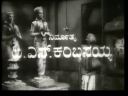
Note that K.R. Seetharama Sastry is credited as Sutradhara, traditionally meaning 'narrator' but here used as synonym for director.
Like in the Mahabharata, the story includes and begins with the occasion of its telling. It brings up one of the big issues about the cinema - the dual history of cinema in the world - on the one hand, tied to the legacy of the stage, on the other hand to the novel as a fictional form. The novel, in pursuit of the reality effect, evolves to eliminate all references to the occasion of the narration itself, the author etc. What we have here then is a theatrical spectator being initiated into the cinema.
photo portrait freezeframe
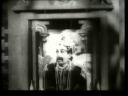
The film begins here and with a photograph (or it could be a painting but is meant to be a photograph) - actually a frame still. The introduction to the cinematic happens at this point.
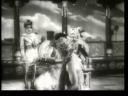
We are here clearly in theatrical space. The camera pulls back and a double image of the king and the king-to-be revealing his skill at martial arts and his capability to take power.
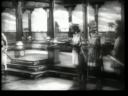
Two pan-right movements, and one cut. Once the frame has a signifying function - a look from inside to outside - then the frame is rendered meaningful. But that is not what is happening here. What happens here is cutting from one ‘set’ to another, and then the establishment of spatial continuity, and again movement from one part of stage to another. Here the cinematic is pulling closer.
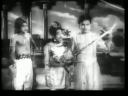
This scene of the Dalwai, or the general. He tells the King that he (the King) should stay in the harem and leave the business of politics to the Dalwai. This is a generic moment in such folk romances, also seen for instance in – the Kannada film
Ranadheera Kanteerava, which in turn is reminiscent of the play by
Samsa Vigad a Vikramaraya. The folk-tale romance hasnot ye evolvedinto a star vehicle in the sense in which Rajkumar would become one later. In these films the star is only a thematic presence, the actor performing the role of a folk Prince. Complicated stories involving intrigues by magicians, heavenly maidens, generals, ministers and head priests, reduce the hero’s role to a small portion of the action. On the whole
Rani Honnamma's aesthetic belongs to an earlier period. In
Sodari, too, Rajkumar is King, but not yet important to the story. In Akkineni Nageswara Rao’s
Keelugurram, likewise. This raises the question whether the southern stars were in fact made outside the films, by fans, before these complicated narratives came to be reorganized to reflect their centrality, or whether their stardom had to await the evolution of the folk romance before audiences detected star presence.
Ranadheera Kanteerava has some aspects of star presence, and
Bedara Kannappa too, but these are not yet fully realized star vehicles. It takes the mixing of this folk action hero’s role with the social for the politically inflected southern star to emerge. This process is completed in the case of Rajkumar with
Mayor Muthanna.
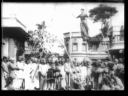
Well done outdoors scene: for a scene that is merely meant to show the Dalwai's cruelty, this sets up an entertainment – an excuse to include a conventional stage performance into a proper screen space. Is this a set? The proximity of the two buildings suggest a set.
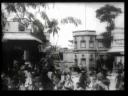
The Dalwai enters. The lack of close-ups is noteworthy, as is the insertion of a cut.

This is an illustrative scene, illustrative of oppression - it doesn't have any other continuity with the narrative.
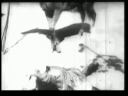
Arguably, close ups of comedians (here Narasimhraju) are almost more frequent than or either the heroic or villainous figures. This conversation happens as the camera swivels left and right, rather than cutting, again a theatrical convention struggling with the cinematic.
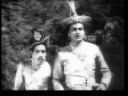
A further aspect concerning the film hero. The hero here is a man of action, rarely the source of ideas. The ideas tend to come from the sidekick, or comedian, and he then acts upon them. Women provide the emotional content while comedians and others give ideas, but action heroes only have to heroically execute plans of action– usually devised by someone else.

This is not the same woman they began pursuing, though they think it was. The scene has shifted, and it is simply ‘a’ woman.
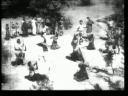
Another dance programme interrupted. The form is the
kolata. Close-ups of the heroine in this scene, note that Rajkumar has not yet been seen in CUs. The spontaneous recognition of a form as ‘Kannada’ here marks a difference from inscribing a form into a cultural layer of meaning.
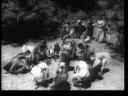
The mark that has been made on him: he says, I am going to live in
ajnathavasa, remove myself from society. At one level, this is simply the temporary conclusion of something, here a particular run of oppression. It had seemed in the film’s beginning that this would be a key part of the plot – the conflict between the young prince and the dalwai, but it is already resolved! The apotheosis that makes them into gods or those who live in the vicinity of gods, the bypassing of a generation - this is in some ways pre-ordained by the
kalanka. This could be the cultural unconscious behind this narrative: in that sense, an acceptance of her, but a false premise - a lie.
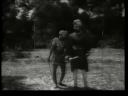
Love at first sight, but under a cloud. There is some avoidance of pollution as if acknowledging the pollution – of her being polluted, which Rajkumar et al deny. The father has made a mistake, but at the same time there is the other fact, that the throne will never be occupied by this couple. There is an avoidance of the ‘contamination’ in the fact that this particular King never actually ascends to throne. Another thing about the love here which is also a part of folklore convention, is that the saviour becomes the owner. She becomes his. (Check D.R. Nagaraj text on romance). An earlier folklore convention of romance, part of an older narrative tradition, is also supplemented by a cinematic romance that will become almost unmanageable.
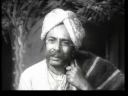
The nature of opprobrium that she faces is indication of what the King has to overcome. Among the conventions of moving the story along is to introduce characters who do not carry over into further scenes. The father tells her to ‘go to whichever god you have chosen’, but as we will see, she has no god yet - she will only get the protection of Rajarajeshwari later in the story.
There is a clear presaging of the future – as something less than the desired happy end, as a mixed blessing. Its exact nature is not revealed. Just as we did not earlier hear what Narasimhraju said to Rajkumar when he told him the way forward, now too we are not privy to what he has told her. There is a problem, but the problem is the essence of the story. You suspend one detail. It is not a secret but rather something held back. Deeper characterization elements do not appear here, the storytelling conventions handle the moral burden entirely.

The dream

Her initiation: which doesn't seem to have much narrative role to play afterwards. But it comes back - the temple story itself is being told here.
Rajarajeshwari becomes a presence in her life, and the story goes into the temple. The elements of the folk tale: since a realist character cannot be found, a combination of folkloric content with purely cinematic devices are used. The cinematic - the cloth, its transparency - not a representation that we can associate with any other form, it is cinematic. The whisper is completely non-theatrical.

Dissolve - the begining of the story?
Love is declared; conjugal couple come together, but under various conditions and constraints - he cannot declare his feelings, she has to do so, and the comedian does his job. The tragic is also presaged.
Her return from
joginihood: evoking so many stories starting with Shakuntala, of maidens falling in love.
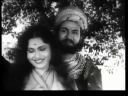
The first instance of the framing of the conjugal couple

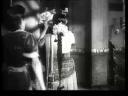
Comedian’s love story. Such romance is not possible for the King or the star. This romance is the stuff of comedy, but it is the more mundane part of the story’s life-world, traditionally reserved for the comedy.
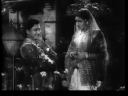
The initiation of the future queen. There is one kind of suspense, for want of a better word: suspension of knowledge in furtherance of a plot. There is a kind of suspense which is more common in Indian popular cultures: a benevolent agent is deliberately conveying a false impression of distress or misfortune or cruelty, making that person suffer, while the spectator is aware that all this is being done with good intent. Remember the film
Adhikar which has an extended ‘play; of this kind. Importantly, such deception is also in order to bring to characters' notice the issues at stake.
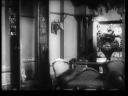
Elements from the social are taken into these older narratives, to give them volume. This is a photograph, photographs converted into paintings - a very modern practice projected back into mythological and folkloric time. There is a similar scene in
Lavakusa - Rama and Sita sitting and reminiscing about their time in the forest, while looking at a series of paintings.

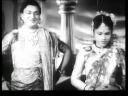
Playing out the deception, stretching it as far as it will go. The woman is repeatedly rejected by her own imagination – she is told by her alter ego that this is to be her fate. There are several below-the-surface cultural resonances, but as a film it is an assemblage. She told the truth, but her conscience says she will not get away from her peasant origins - but the truth is the main focus. She cannot conceal this from her husband. Suffering is the prerogative of the woman – but the consequence of the affect is the arrival of the cinematic. In that way, both women who feel, and who convey feelings and emotions, and comedians who speak the unspeakable, produce that affect. Heroes do things, perform acts, but have no thoughts of their own. Heroes do things that affect other people. It is all such affects that define the cinema, as it draws on affect as the most cinematically exploitable thing in the folklore form.

Happiness, but under a cloud - happily except… New troubles are coming their way. He has now become a victim. Although we can treat this as just another in the series of adversities Leelavathi has faced, this one is something else. Is the film's cosmos now different from, indeed larger than, what we had so far understood? When differences arise between, and clashes take place over, heavenly characters doing mischief, we read this simply as a story. Here something additional happens: something that is being inscribed into a narrative that has now given us earthly forms of suffering. In Sodari the King leaves, having nothing left, and sends his wife and child to her brother's kingdom. She suffers in his absence. Here the film clashes two registers of suffering, and hence registers between the social and the folk as well: a clash between earthly and unearthly suffering.

The
apsaras have their own moral differences. One lot says let's get away, but she defends her action saying he held my hand and so he is mine. Rather than ascribe pleasure-seeking as the sole motive, the
apsara is made to resort to an earthly, moral reason.
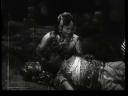
Rajkumar shown helpless, a puppet in the hands of the
apsara, another sign of the pre-stardom stage in his career.
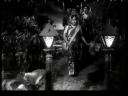
The tragedy speaks to the destinal aspects - the story's next stage is already the reference point for the dialogue. The mother-in-law develops a different portrayal: earlier, she was very particular about who her son marries, but now she supports the daughter-in-law. The happy scene is immediately followed by tragedy – by swings of fortune – as happiness is always shown, inevitably, as under a cloud. Narratologists might ask, what is there about a culture where fortunes undergo such swings? But what we are actually experiencing here is a dissonance with our own spectatorial histories, where our training is in a cumulative process of storytelling, and the memory of a previous scene is carried over into the next. Arabian Nights stories do not work like that. The cultural base is speaking here - the actual cultural context is speaking through her: the culturally-embedded narrative. Another woman in another cultural context may speak differently. There is a compulsion for integration which does not always work - it has parts that do not always fit, and in any case, as we have been saying about the Indian cinema, they have resisted that kind of integrity. The well-finished social form of the 1960s would later provide an integrated alternative to Hollywood. The cinema standardizes these different components and integrates them into an organic form that dominates the film industry. It could have also gone in another direction, one that might have eliminated non-causal extraneous elements and taken it inthe direction of hollywood. Genre films tend to have more or less extreme genericization, in the sense that any situation already comes with certain readymade speech modes that are suitable for the moment. The moments of life are already prefixed – your birth, your marriage, death of a loved one - all these things have fixed, transcendent meanings, the speech is appropriate to the occasion, because the culture has ordained it, and the film does no more than simply repeat that.

Item song - the possibility of the Bombay cinema's influence: stands out. It may be worth seeing if this particular set repeats itself in other films.
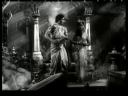
The basic conflict between duty and love - this man is married, and now there is an offer of heavenly pleasure - so this is his misery, his misfortune. Being a man, his problem is the duty that calls him: pleasure is the misfortune he must face. He knows his destiny is to rule. Threat of Mohini also refers to Urvashi-Arjuna, where Arjuna is accused by Urvashi for not accepting the pleasures offered.

She ascends to heaven - they meet, but under a cloud - meanwhile... (tilt-down)
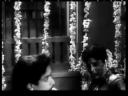
The comedian comments on the main situation but here the resolution is quick, and not tragic or long-drawn. He thinks the hero is on a mission, and not just dead.
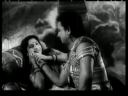
When the king is not in his kingdom they are equal - heaven is an equalizer, a reverser of roles. it is as though heaven is a big building with many rooms, the
apsaras are in one room and he had to keep her away from it. She says, ‘I should be serving you, how can I let you do it for me’.
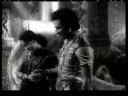
The fact that he gives her the
amruta and then give her the ring, he has made her immortal. The ring is not his ring, it belongs to Mohini, and to protect her from Mohini’s wrath.
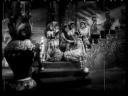
Mohini is developing doubts - what if Rajkumar does not keep his promise Her
sakhis recommend the use of a
mohanastra, to keep him in thrall.
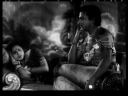
This difference between humans and immortals - all his statements for describing human love are in immortal terms. She confirms that these sentiments are there, but that nobody has understood them because they have never seen then – that metaphors are decoys, of pleasure. She now makes him into a zombie - this is standard. Conventionally, the state he now comes into is the state where stories take off - so there is a problem. The
vrata, that he shall see her one last time - that is unusual. There are two options for him: one, that he should be in the harem, another that he should do his duty. His bargain with the
apsara is to first of all see his wife, assuming that he planned it all in advance, and secondly to trick the
apsara.
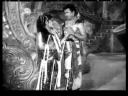
1. He loses his mind and is under Mohini's spell; 2. The comedian couple replay that dilemma - of duty versus conjugality; 3. This couple are the only two who believe. She says that since you went and came, you are probably pregnant. 4. Princess now believes she IS pregnant. 5. This is a confirmation to the queen mother that she is delusional.
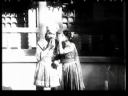
The beginning of the intrigue. The Dalwai, who is trying to stir up a rebellion against the king, now returns. The King is completely ignorant of everything that has happened. The plot depends upon human belief in heaven - and yet the characters behave as though heaven is an illusion. We have here a fantasy film but a psychological-realist attitude, and it is precisely this that is now causing the problem.
Honnamma reveals herself to the Dalwai, and threatens him against speaking ill of herself. The death threat and punishment - which he tries to gloss as an act of impartial justice which will enhance the King's reputation among the public. He says to the King that the sin of killing a pregnant woman will be mine. He contradicts himself, saying that he is doing the punishing, but he cannot be the one doing it. The concept of
bhruna-hatye; which is equivalent to
brahma-hatye - and a King approving that - both approving and disapproving. Honnamma is in a stage where she is going to make a prediction, that her son will avenge her. This is like a wager, one made upon her honour. This is the first appearance of Honnamma the queen, as Rani Honnamma. The secret of her lowly birth is directly revealed. Elsewhere this may have allowed the plot to take a further twist. Here, her charge against the Dalwai is simply ignored by the King. The relationship between a King and his Dalwai - the theory of state in which the King limits himself to the symbolic, and keeps in the harem - as against the King who is aware of state affairs – has been a topic of discussion in Kannada (cf. Haider Ali and Tipu Sultan, or Samsa's Vigadavikramaraya where the King spends his time in the harem and Vikramaraya plots to kill him.. The symbolic political question does not necessarily extend to the people. This is more about the preservation of the monarchic royal family.
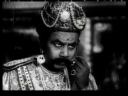
The miracle scene in which the Queen displays her impartiality.
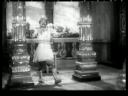
The palace coup - spectatorially, since everything is known, this is the moment to act, for the King. If someone could defeat death, therefore they must be true. The King is willing to engage Kattanayaka in a sword fight - the magnitude of the change is serious. The comedy interlude provides a support system - they will do something to help while their masters are in distress.
Second big song hit - important because of Rajkumar's participation. Her lines are about love, his are fascinated by the place that he is in. He is a reluctant participant. He is under her spell but this is not a love relationship.
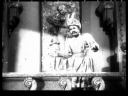
Introducing the new character - Haleri Narasanayaka - whom the Dalwai tries to placate by sending the statue of Rajarajeshwari to the childless king.
The child birth among the tribals
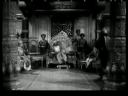
The king is organizing a tiger hunt. Parallelly, a clear reference is made of the social message of the
poojari and tantric - but they are listening to him, which means his word is honoured. The
narabali - human sacrifice - is the beginning of a treasure hunt. Kechaiaiah is the tribal chieftain, needed for the hunt, but he is presumably with the sacrifice. They interrupt the sacrifice and believe that the child's arrival is the goddess Rajarajeshwari's doing.

Episodes of the loss of the son - finding shelter with a courtesan.
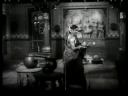
First scene of the sequence - the courtesan considers Honnamma a harbinger of life, and yet Honnamma is unable to react to it. The big song celebrating the child to the new King. The plot requires that she needs to be somewhere with the statue. The story has arranged for her to be in this place. She is in a brothel without the anticipated harassment that a brothel will submit her to. She does not need to learn dance or perform any other services.
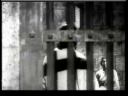
The King and queen in dungeon, the recognition scene. The king is speaking of the fragility of human behaviour - why, when someone has tasted heaven, would they even want to come back to the mortal world? Queen has faith not only in her son but in her daughter-in-law.

The son and his talking horse. Mother and son recognize each other immediately.

She returns to father, re-encounters the priest, and then with the very
tapobal she sets heaven on fire. Of interest is the way time is marked - when she comes back, after having done this to heaven and got her husband back, she is asked by her father what she was doing - and she says she went out to pay her respects to a
sadhu.
Climax - and Rajkumar is a bystander, the entire climactic fight being fought by others while he stands and watches. For many films of the time, you have the hero who is symbolically central but actually marginal to the plot. With the star figure becoming more and more central, this changed.
Indiancine.ma requires JavaScript.
